Health tech: drug management platform for PBMs and health plans | Nationwide

CliniVantIQ: a prelaunch health tech site with its own booking engine

CliniVantIQ is building a drug management platform for pharmacy benefit managers (PBMs), health plans and managed care organizations. This healthcare website design project took clinivantiq.com from a GoDaddy placeholder to seven pages, an interactive product tour and a custom intro-call booking engine in 23 days.

  • Website Design
  • Custom Web App
clinivantiq.com
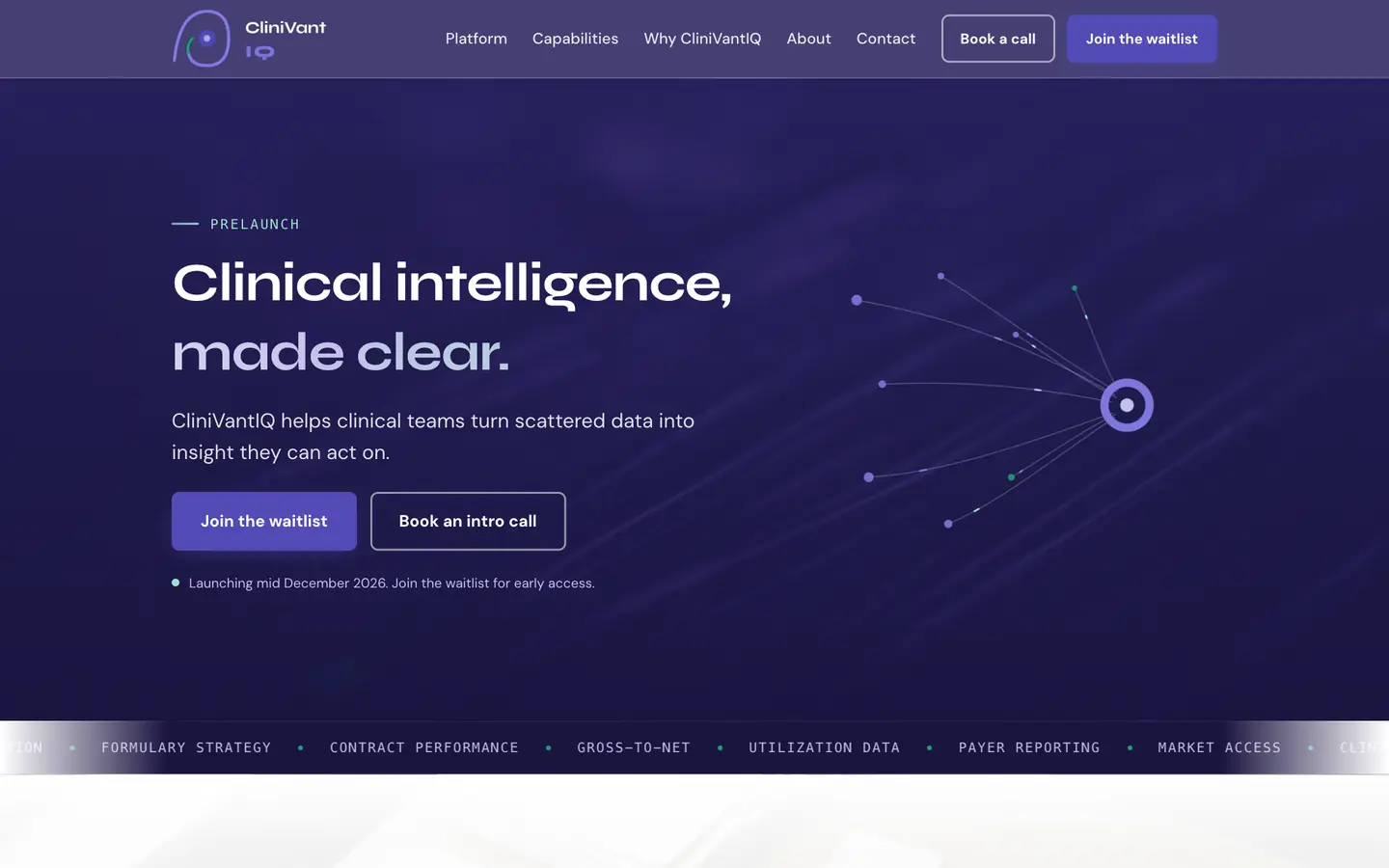
The CliniVantIQ site on a desktop screen
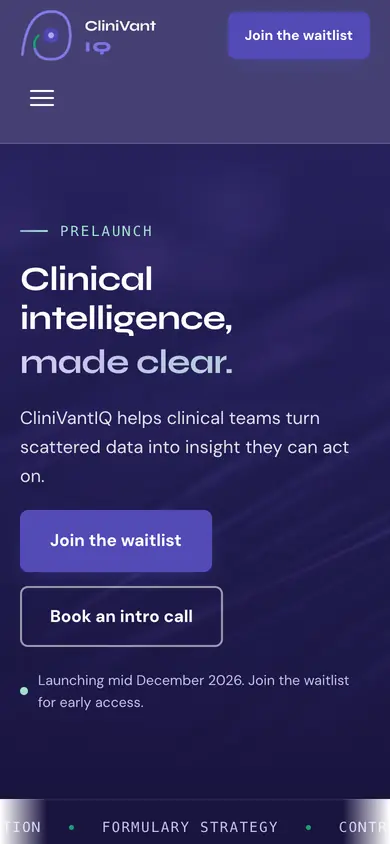
The CliniVantIQ site on a phone
23 days
from first build to the live domain
First commit on 2026-09-26 to the DNS cutover on 2026-10-19, including a change of audience mid-build
1 day
to restructure the site for a new buyer
2026-10-07: six pages rebuilt for the payer audience from the founders' October brief
5
real product screens in the home page tour, each in light and dark
From the client's demo platform, 10 images in all, each shown with a demonstration-only note
The client

About CliniVantIQ

CliniVantIQ is a healthcare technology company that serves the payer side. Its platform covers the work of drug management teams at PBMs, health plans and managed care organizations: formulary and drug list management, utilization management, P&T review and value placement decisions. The product launch is planned for mid-December 2026, so the website's job is to start conversations first. That made this a healthcare website design project with a B2B reader: the people who run drug management, not patients.

The challenge

Why They Came to Us

The founders' first brief asked for one scrolling page with two jobs: build a waitlist and start conversations with teams ready to talk. Their measure of success was waitlist sign-ups and intro calls booked.

  • The domain, clinivantiq.com, showed only GoDaddy's one-page Launching Soon placeholder, and the Microsoft 365 email already running on it had to keep working through launch.
  • The audience changed mid-project: the founders' October brief named the buyer as drug management teams at PBMs, health plans and managed care organizations.
  • The product was still in development, so the site had to show real screens without presenting demo data as real results.
  • Booking had to work before any scheduling tool or CRM was chosen; the brief still listed HubSpot Meetings or Calendly as to be confirmed.
  • The brand book set firm rules: Syne and DM Sans, a purple palette, dark rows that open and close each page, sentence case, and the word patient, never member.
The plan

What We Proposed

We built to the founders' briefs, then ran a research audit on October 9 that ranked what to add next.

  • September: a prelaunch home page to the developer brief, with the problem, how it works in four steps, principles and a sign-up block. The founders approved it.
  • October 7: a six-page structure for the payer audience, using the founders' October brief as the copy source.
  • October 9: a ranked list of additions led by a security and data page, founder bios, an FAQ page and a booking flow. The booking flow was built first.
The build

What We Built

Website

Seven pages for the payer audience, built around the home page the founders approved.

  • Home keeps the approved September design, including the animated convergence hero the client asked to keep, with a product tour, "Who it is for" and "How we build" rows added.
  • Platform shows eight lifecycle stages along a line that fills as you scroll, with real screens on four of them and stages 3 to 5 grouped as parallel reviews.
  • Capabilities, Why CliniVantIQ, About, Contact and Book pages round out the site, and every page shares one header and footer, so the menu, email and booking link change in one place.
  • Brand book followed: Syne and DM Sans self-hosted, the purple palette, 14px minimum labels and sentence case.
  • Organization and breadcrumb schema, a sitemap, and the temporary build address forwarding to the real domain.

Product tour and decision trace

Two interactive pieces that show a product still in development without overstating it.

  • The home page tour steps through five real screens from the client's demo platform, each in light and dark: drug pipeline, drug monograph, rules engine, conflict resolution and where the week went.
  • Tabs autoplay every 6.5 seconds with a progress bar until a visitor clicks; a Light/Dark toggle swaps every screen, and a click opens any screen full size.
  • A demonstration-only note sits under every screen.
  • On the Platform page, the decision trace walks one coded formulary entry back through the placement decision, the parallel reviews and the classification to its FDA source, using a fictional drug labeled as such.
  • The trace plays once when scrolled into view, and all of its content sits in the HTML, so it reads in full without JavaScript.

Booking engine

A custom intro-call booking flow at /book, running on its own serverless function with no third-party scheduler.

  • Visitors pick a weekday slot shown in their own US time zone, then answer seven short question cards and review before booking.
  • Page and server share one set of availability rules, so the server accepts only slots the page could offer and turns away a slot someone just took.
  • Each booking is saved before any email goes out, and the admin alert carries a one-click link that creates the calendar meeting with the guest already added, plus an .ics file.
  • Visitors get a confirmation with Google, Outlook and .ics calendar links, and if the alert fails they see a real fallback, never a fake success.
  • Booking mail sends from the company's own domain, with replies going to their public contact address.
Problem solving

How We Solved the Hard Parts

  1. A new buyer after approval

    When the October brief named the payer side as the buyer, we restructured the site into six pages in a day. In the final structure, the approved home page stays, and the new depth lives on inner pages linked from it.

  2. Showing a product that is not out yet

    We used the client's real demo screens with a demonstration-only note under each one, because the demo uses illustrative data. The worked example on the Platform page uses a fictional drug and says so.

  3. Booking with no scheduler or calendar sync

    One shared set of availability rules runs on both the page and the server, so a slot cannot be booked twice, and each booking is saved before any email goes out. Calendar links and .ics files do the job a calendar integration would.

  4. Launching without breaking email

    The domain already ran Microsoft 365 mail. We left its mail records untouched at cutover and checked them again on two public DNS resolvers, and the site's security certificates issued without manual steps.

Results

The Results So Far

CliniVantIQ's site went live on October 19, 2026, ahead of a product launch planned for mid-December. Live today: seven pages for the payer audience, the light and dark product tour, the decision trace and the booking engine at /book.

It is too early for results. The founders set the yardstick in their first brief, waitlist sign-ups and intro calls booked, and that is what we will watch.

Stats are build facts from the project's git history and files: the first commit on 2026-09-26, the restructure on 2026-10-07, the DNS cutover on 2026-10-19 and the screens in the home page tour.

Timeline

Project Timeline

  1. First build of the prelaunch home page
  2. Founders' October brief names the payer audience
  3. Site restructured into six pages for the payer side
  4. Booking engine and product tour added
  5. Live on clinivantiq.com, with booking mail from the company's own domain
Questions

Questions About This Project

Why build a booking engine instead of using Calendly?

The founders' brief left the scheduling tool undecided, and WES's standard form service could not carry calendar links for each booking. A small serverless function checks the slot, saves the booking first and sends calendar links from the company's own domain.

How do you show a product that has not launched?

With the client's real demo screens and a demonstration-only note under each one. Where the site needed a worked example, the decision trace uses a fictional drug and says so.

Can the client update the site?

Yes. The site is connected to My AI Editor, and the client was invited to edit it on launch day.

More work

Related Projects

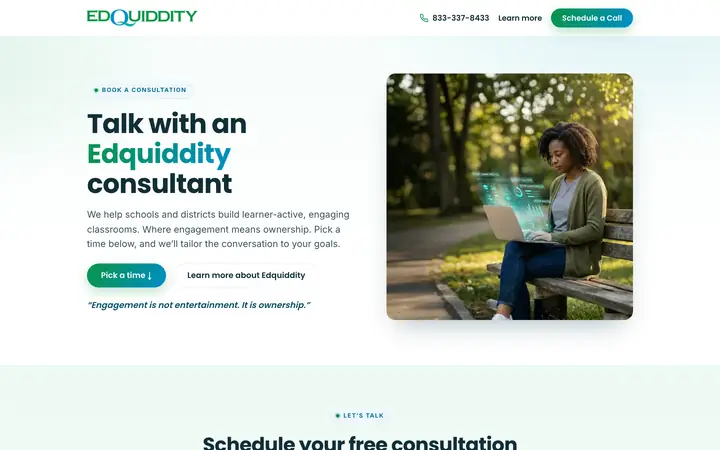
Edquiddity website
Coaching, Education & CommunityFeatured

Edquiddity

K-12 professional learning for schools and districts, Naples, FL

A live booking hub and two-brand Content Studio, plus a staged 69-page site rebuild and member app for a K-12 learning company.

412old and current URLs inventoried before the rebuild
Website DesignContent StudioCustom Web App
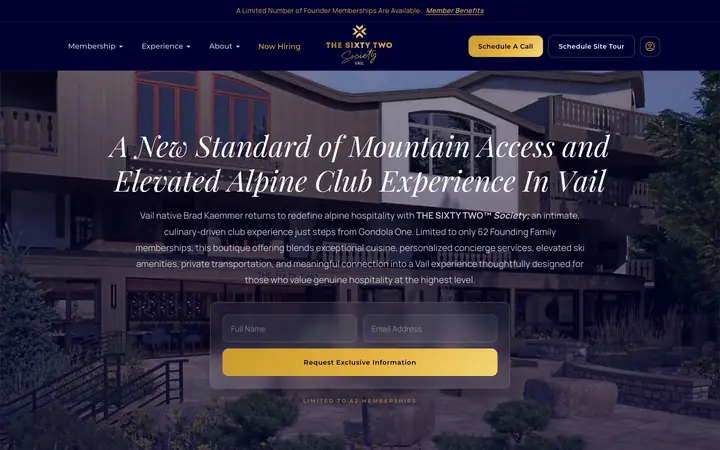
THE SIXTY TWO™ Society website
Hospitality & EntertainmentFeatured

THE SIXTY TWO™ Society

Private members club with dining, ski valet, transportation and concierge, Vail, CO

A Duda migration plus a custom staff and member app for a private Vail club, with a host book, server tablets and 10 AI features.

66 to 98WES SEO audit score

Website DesignWebsite MigrationCustom Web AppAdmin PortalGoogle AdsSEO

See the Full Portfolio

Want a Website That Works This Hard?

Tell us about your business and where your leads come from today. We will show you what we would build, and what we would keep.